 The Steady Supply

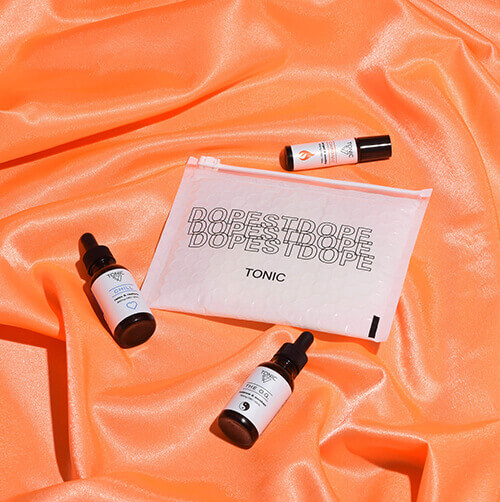 Personalized Vibes
Lemon Balm for Stress, Sleep, Digestion, Mood AND Focus?!
Lemon balm (Melissa officinalis) has been used for more than 2,000 years, and this little lemon-scented member of the mint family has accumulated quite the resume along the way.
Ancient herbalists used it for relaxation, digestion, mood and sleep. Today, researchers are investigating many of these same traditional uses through randomized clinical trials, including studies examining lemon balm’s effects on stress, anxiety, sleep quality and cognitive performance.
While the research is still developing, several clinical trials have produced encouraging results, particularly around stress and emotional wellbeing.
Here’s what we know so far.

The History
Lemon balm is a perennial member of the mint family native to the Mediterranean region through Central Asia. Its botanical name, Melissa, comes from the Greek word for honeybee, and the plant has a long history of cultivation around bees and use as a fragrant medicinal and culinary herb.
Its medicinal history goes way back. References to lemon balm appear in ancient Greek and Roman herbal traditions, including Dioscorides’ De Materia Medica in the first century CE. Centuries later, it became an important herb in Persian and European traditional medicine, where it was used for nervous complaints, digestive symptoms and sleep.
By the Renaissance, lemon balm had developed a reputation as an herb for calming the nervous system and supporting mood and memory. Herbalists recommended it for a variety of nervous and digestive complaints, and its use continued throughout European traditional medicine.
Its traditional use also extended beyond Europe and the Mediterranean. Ethnobotanical records document lemon balm use in South America, including traditional preparations among Indigenous communities in Brazil. Among the Xakriabá Indigenous community, for example, Melissa officinalis has been documented as a tea used traditionally for insomnia, fever, flu and digestive complaints.
So humans have been reaching for this little lemony plant for a very long time.

Lemon Balm & Stress
One of the most studied modern uses of lemon balm is its potential effect on stress and anxiety.
In a randomized, double-blind, placebo-controlled crossover study, 18 healthy adults received either 300 mg or 600 mg of standardized lemon balm extract or placebo before completing a laboratory stress test. The 600 mg dose reduced the negative mood effects of the stressor and increased participants’ self-rated calmness. The 300 mg dose also improved the speed of mathematical processing without reducing accuracy.
Another randomized clinical trial looked at 80 people with chronic stable angina who took either 3 grams of lemon balm or placebo daily for eight weeks. The lemon balm group experienced reductions in anxiety, stress, depression and overall sleep disturbance compared with placebo.
A 2021 systematic review and meta-analysis of randomized clinical trials also found that lemon balm significantly improved anxiety and depressive symptom scores compared with placebo.
And there is now some newer research looking at what lemon balm may do during periods of cognitive stress.
A 2026 randomized, double-blind, placebo-controlled study included 106 healthy young adults with moderate subjective stress. Participants received either 300 mg of a standardized lemon balm extract or placebo during a day involving periods of cognitive overload. The lemon balm group performed better on the most demanding executive-function tasks five hours after taking the extract and showed better recovery of calmness following periods of cognitive demand.
The bigger picture is that several human studies point toward lemon balm’s potential role in supporting calmness and emotional wellbeing, particularly during acute stress.

Lemon Balm & Sleep
Lemon balm has also been studied for sleep, both on its own and in combination with other herbs.
A 2024 randomized, double-blind, placebo-controlled crossover study examined a highly standardized lemon balm extract formulated as a phytosome, a delivery system designed to improve absorption of its plant compounds. Participants taking the lemon balm preparation experienced a significant reduction in insomnia severity compared with placebo. The researchers also observed changes in sleep-stage measurements and reported that 87% of participants in the treatment group reported improved sleep quality compared with 30% in the placebo group.
Another randomized, double-blind clinical trial gave 100 adults experiencing emotional distress or poor sleep a standardized lemon balm extract for three weeks. Compared with placebo, the lemon balm group showed improvements in measures of anxiety, stress, depressive mood, emotional wellbeing and sleep.

Lemon Balm & Cognitive Function
Lemon balm isn’t only being studied for relaxation. Researchers have also looked at its effects on attention, memory and cognitive performance.
In one randomized, placebo-controlled crossover study, 20 healthy young adults received different doses of a standardized lemon balm extract. The researchers found improvements in attention following a 600 mg dose, along with changes in self-rated calmness.
Another study found that a higher dose of dried lemon balm leaf improved memory performance and increased calmness in healthy participants.
And the 2026 cognitive-overload study adds another piece of human evidence, finding improvements in some demanding executive-function tasks following 300 mg of standardized lemon balm extract.
Wait, supporting a calmer mental state may also create better conditions for attention and cognitive performance? Relaxation and cognitive performance don’t have to exist on opposite ends of the spectrum?! Huge. We’re here for it.

What’s Actually In Lemon Balm?
Lemon balm contains a variety of biologically active compounds, including rosmarinic acid, flavonoids and volatile compounds found in its essential oil.
Rosmarinic acid is one compound researchers have paid particular attention to because of its potential effects on pathways involved in GABA metabolism. GABA is an inhibitory neurotransmitter involved in regulating nervous-system activity, which is one possible explanation for some of lemon balm’s calming effects.
Learn more about GABA here – it’s basically like your nervous system’s break pedal when it’s too activated.
Lemon Balm + Chill TONIC
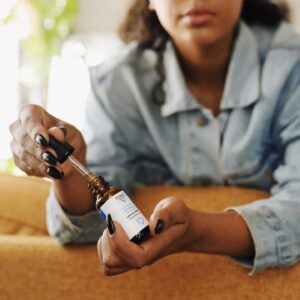
This is one reason lemon balm has a natural place in Chill TONIC.
Chill combines CBD with ashwagandha, lemon balm, passionflower and black seed oil to create our most zen blend, designed for those times when you want to support calm and/or sleep
CBD has been studied for its potential effects on stress, anxiety, sleep and overall wellbeing. Ashwagandha is an adaptogenic herb with clinical research supporting its potential to help reduce perceived stress and support a more balanced stress response. Passionflower has also been studied for anxiety and sleep. Are you sensing a pattern here? Black seed oil, traditionally used for centuries and studied for its antioxidant and anti-inflammatory health-supporting properties, rounds out the botanical lineup in Chill TONIC.
In other words, Chill isn’t relying on one magical ingredient to do all the emotional heavy lifting. It’s a team effort.
And honestly, in 2026, we could all use a team.