

 The Steady Supply

 Personalized Vibes
The Science of Dopamine: Why Everything Feels Boring Now
Remember when watching a movie was enough entertainment? When you could read a book without checking your phone 14 times? When going for a walk was an activity instead of something you needed to podcast, audiobook, and Instagram-story your way through?
If lately it feels like your brain has the attention span of a caffeinated squirrel, you are not necessarily imagining it.
We live in a world engineered to keep us stimulated. Notifications. Reels. TikToks. Streaming. Online shopping. Endless news. Dating apps. Video games. Group chats.
Enter dopamine.
Dopamine has become the wellness industry’s new favorite word, blamed for everything from procrastination to phone addiction to your inability to enjoy a quiet Sunday afternoon. But dopamine isn’t actually the “pleasure chemical,” and you probably haven’t “depleted” your dopamine by scrolling too much.
The real science is much more interesting.

So… What Is Dopamine Actually Doing?
Dopamine is a neurotransmitter involved in a whole lot more than pleasure. It plays important roles in motivation, learning, movement, attention, reinforcement, and reward-related behavior.
One of its most fascinating jobs is helping your brain learn what is worth pursuing.
Dopamine neurons respond to discrepancies between what your brain expects to happen and what actually happens, a concept known as reward prediction error. When something unexpectedly good happens, dopamine signaling can increase. When the reward is predictable, the response can shift toward the cue that predicts the reward.
In other words, dopamine isn’t simply screaming, “YAY! FUN!”
It’s more like:
“HEY. PAY ATTENTION. THIS MATTERS. REMEMBER THIS. MAYBE DO IT AGAIN.”
Dopamine is deeply involved in the process of turning experiences into learned motivations. It helps your brain decide which cues, behaviors, and outcomes deserve attention and future effort.
Which brings us to our modern predicament…
Your Brain Was Not Designed for Infinite Novelty
For most of human history, rewards were relatively effortful. You wanted food? You had to find or grow it. You wanted social connection? You had to physically interact with other humans. You wanted entertainment? Congratulations, you invented a drum.
Today, the average smartphone contains an essentially unlimited supply of novelty and reward cues, available with the movement of one thumb. And the important part isn’t simply that these things feel good. It’s that many digital environments are designed around variable, unpredictable rewards.
You don’t know what the next notification will say. You don’t know what the next video will be. You don’t know whether the next swipe will bring you something hilarious, interesting, shocking, attractive, infuriating, or completely incomprehensible. That unpredictability is incredibly good at keeping attention.
Recent neuroscience research suggests dopamine signaling is more complex than the simple “pleasure chemical” story we’ve been telling online for years. Dopamine is involved in learning, prediction, action selection, and assigning motivational significance to cues.
So when your phone keeps offering your brain something new every few seconds, you’re not necessarily “draining your dopamine.” You’re training your attention toward novelty and immediate feedback. And that can make slower, quieter activities feel… well… painfully slow.

Why Does Everything Feel So Boring?
Here’s the uncomfortable part: sometimes your favorite activities haven’t actually become less enjoyable, your brain has simply gotten very accustomed to high-frequency stimulation. Think about the difference between eating one square of dark chocolate and eating an entire bag of candy while standing in front of the pantry questioning every decision that brought you here.
The first one might feel nuanced. The second one is basically your taste buds at a rave. Digital stimulation can work similarly. When you’re constantly switching between texts, videos, emails, news, music, and notifications, your brain is repeatedly being asked to orient toward something new.
Then you try to sit down and read 20 pages of a book and your brain is like, “Okay but where are the plot twists every seven seconds?”
This doesn’t mean your dopamine receptors are “broken.” It means attention and motivation are shaped by learning and repetition. If your environment constantly rewards rapid switching and novelty, sustained attention can feel comparatively effortful.
Research on problematic smartphone use has found associations with altered reward processing, heightened cue reactivity, and differences in executive-control networks. That doesn’t mean every person who owns an iPhone has a neurological disorder, but it does suggest that problematic use can involve meaningful changes in how reward cues and self-regulation interact.
Your phone isn’t evil. Your brain isn’t broken. But your attention is trainable.

The “Dopamine Detox” Isn’t Really a Detox
You’ve probably heard about dopamine detoxes, in which people attempt to avoid basically everything enjoyable for 24 hours. No social media, music, TV, sugar, talking, maybe even eye contact. Just you, a blank wall, and the consequences of your life choices.
The problem is that the name is misleading. You don’t need to “flush dopamine” out of your brain. Dopamine isn’t a toxin, and there isn’t good evidence that a weekend without your phone literally resets your dopamine system.
A review of the dopamine-fasting concept found that the popular idea isn’t supported as a literal way to correct “dopamine dysregulation.” However, reducing compulsive exposure to highly stimulating digital activities can still be a reasonable behavioral strategy for improving your relationship with technology.
So instead of a dopamine detox, think of it as a stimulus reset. The goal isn’t to stop enjoying things, it’s to give your brain opportunities to experience reward from things that require a little more time, attention, effort, and presence.

How to Support a Healthier Reward System
1. Make Boredom Legal Again
This may be the most revolutionary wellness practice of all. Go for a walk without your phone in your hand. Stand in line without immediately opening Instagram. Drink your coffee without simultaneously consuming 150 pieces of information. Let yourself just stare out a window for a while.
At first, it might feel unbearable. That’s okay. Boredom isn’t necessarily a problem that needs to be solved. It’s also an opportunity for your attention to settle.
2. Stop Making Everything a Double-Screen Event
Watching television while scrolling your phone. Eating dinner while watching YouTube and also scrolling on your phone. Working while answering Slack messages while checking email while listening to a podcast.
We have somehow turned every activity into a group project. Try doing one thing at a time. Your brain will survive.
3. Put Friction Between You and Your Most Compulsive Apps
You don’t need to throw your phone into the Hudson River. Start smaller.
Turn off unnecessary notifications. Move distracting apps off your home screen. Use app limits. Keep your phone out of reach while working. Charge it outside the bedroom.
The goal isn’t perfection. It’s making the automatic behavior slightly less automatic.

4. Do Things That Require Effort Before Things That Provide Instant Reward
This is one of my favorite ways to think about motivation.
Instead of:
Wake up → phone → social media → email → news → existential crisis → coffee
Try:
Wake up → sunlight → water → movement → breakfast → then phone.
Just try to give your brain a chance to engage with slower, effort-based rewards before flooding it with instant stimulation.
5. Move Your Body
Exercise isn’t just about muscles and metabolism. Physical activity interacts with brain systems involved in mood, motivation, cognition, and reward. And unlike scrolling through 400 videos of strangers doing Pilates in matching beige sets, exercise gives your brain an actual sensory experience to process.
Walk. Lift weights. Dance in your kitchen. Ride a bike. Do yoga. You don’t need to become a marathon person, you just need to move your body in whatever way feels good.

6. Protect Your Sleep
Sleep and reward systems are deeply connected. Research suggests that sleep and circadian rhythms influence neural reward pathways, and sleep disruption can alter dopamine signaling and reward responses.
So if you’re exhausted, unmotivated, craving stimulation, and reaching for your phone every 90 seconds, the answer may not be another productivity hack. You may need to go to bed.
7. Seek Out the Good Kind of Dopamine
Dopamine isn’t the enemy. You want motivation, curiosity, anticipation. You want to feel excited about things! The goal is not to eliminate dopamine. It’s to cultivate healthy sources of reward.
Learning something new. Cooking a meal. Finishing a workout. Creating something. Spending time with people you love. Getting outside. Making progress on a goal. Reading an entire chapter without checking your phone.
These things may not deliver the same immediate hit as an endless scroll, but they can create something much more valuable: satisfaction that isn’t dependent on constant stimulation.

And Then There’s the Nervous System
Here’s where dopamine gets particularly interesting.
Your brain doesn’t operate in isolation. Motivation, attention, sleep, stress, arousal, and reward are all interconnected. Chronic stress can make it harder to focus, rest, and engage with everyday activities, while poor sleep can influence reward processing and motivation.
So sometimes “I can’t make myself do anything” isn’t a character flaw. Sometimes your brain is overstimulated, you’re exhausted, you’re stressed, you’re under-recovered. And sometimes you’ve simply spent three hours scrolling and accidentally trained your brain to expect novelty every 2 seconds.
Where TONIC Comes In
Supporting your brain doesn’t have to mean turning your life into a monastery. The goal is balance.
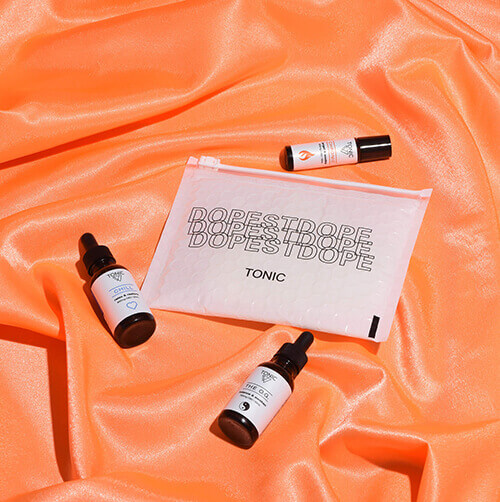
The O.G. TONIC, with CBD and ashwagandha, was created for those moments when you want to take the edge off without turning yourself into a human puddle. Ashwagandha is an adaptogenic herb that has been studied for its effects on stress and anxiety, while CBD interacts with a complex network of receptors and signaling systems throughout the body to also aid in calm and anti-inflammation.
For those moments when your brain is less motivated genius and more overstimulated raccoon, creating a calmer baseline can make it easier to step away from constant stimulation and reconnect with what actually feels good.
And if you REALLY need to chill out, Chill TONIC combines CBD with ashwagandha, lemon balm, and passionflower for the ultimate calming blend – great for sleep or higher levels of anxiety during the day.
Because sometimes the most productive thing you can do for your dopamine system is stop asking it to entertain you😃

The Bottom Line
You probably haven’t ruined your dopamine. You don’t need to live in a cave. You don’t need to delete every app, give away your television, or spend a week sitting silently in a room with nothing but a bowl of lentils.
But if everything feels boring lately, it might be worth asking a different question:
Have I lost interest in everything… or have I simply become accustomed to being constantly stimulated?
Dopamine is not the enemy. It’s part of the incredibly sophisticated system that helps your brain learn, seek, adapt, and decide what is worth your effort.
So give it some better things to work with. Take the walk. Read the book. Make the meal. Call the person. Sit outside. Do something badly just because it’s fun.
And every once in a while, put your phone somewhere you can’t reach it and let your brain remember that nothing happening for 20 minutes is not, in fact, an emergency.
Life may still feel like a three-ring circus, but your brain doesn’t need to be the guy juggling flaming bowling pins.
