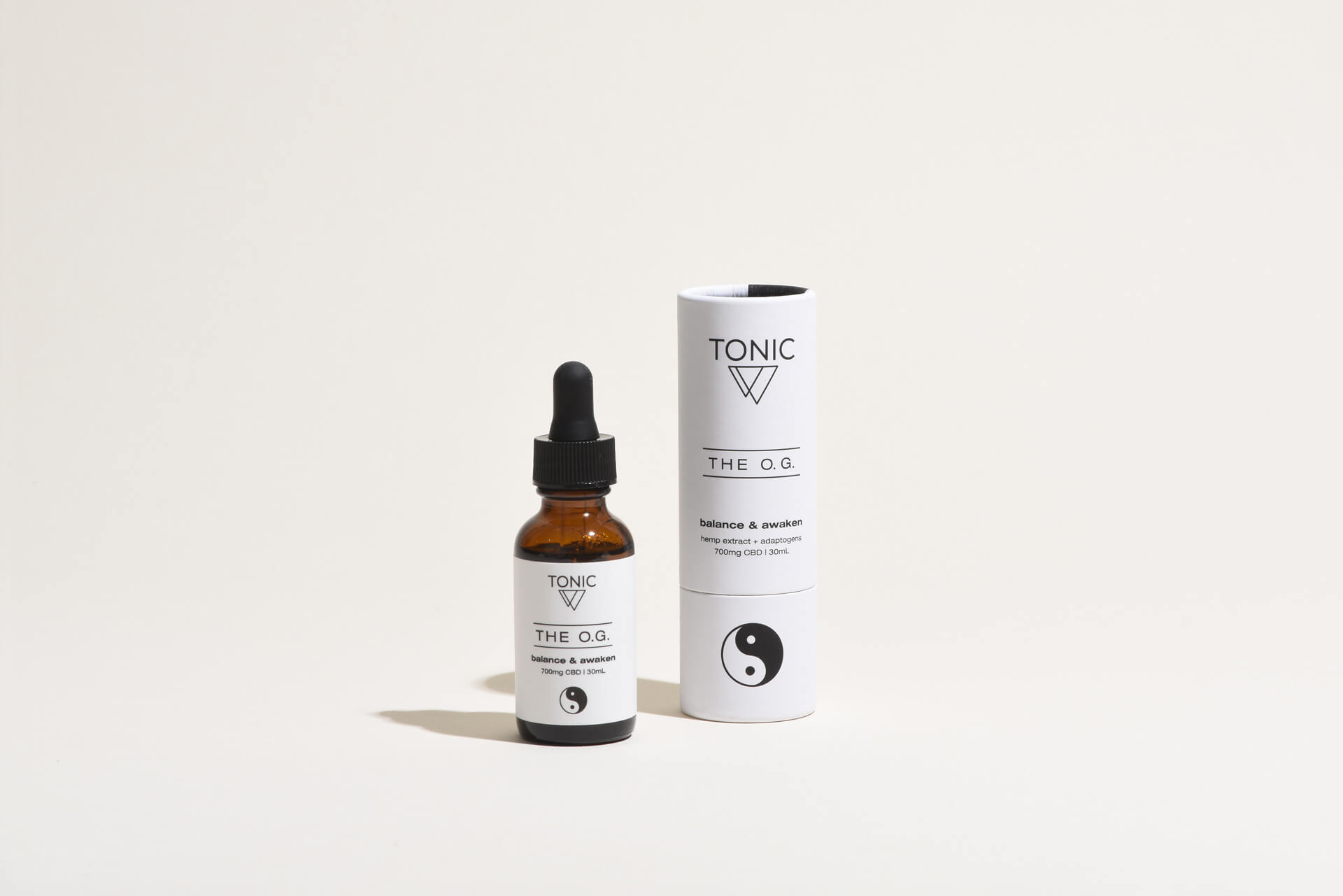
 The Steady Supply

 Personalized Vibes
Symptoms Are Signals: Here’s How To Listen
What if feeling off isn’t the problem? What if it is the point?
AKA: what if your symptoms aren’t problems… they’re signals.
Somewhere along the way, we decided every symptom is a glitch that needs fixing immediately. (Complex developmental trauma is so cute, right?)
Headache? Fix it. Fatigue? Override it. Anxiety? Silence it. Bloating? Take so many supplements that you don’t even know what’s helping or hurting.
But your body is not a broken machine. It is more like a very opinionated friend who keeps sending you texts like:
“Hey… this isn’t working for me.”
And instead of reading the message and learning from it, we block the number.
Symptoms are not random acts of betrayal. They are communication.
Your body always knows.
The issue is we have been trained not to listen.

Wellness Is Less Like Math… and More Like Taste
We love a formula. Tell me exactly what to take, when to take it, how much, how often, and promise me I will feel like a dewy-skinned goddess by Thursday. To-do list ✅ Dopamine ✅
Unfortunately, your body did not get that memo. Wellness is less like solving an equation and more like developing a palate.
Think about it. You were not born knowing the difference between good coffee and “why does this taste like burnt regret.” You learned. You paid attention. You refined your taste.
Your body works the same way.
There is a version of you that knows:
🤝 what kind of movement actually feels good
🤝 what kind of rest is restorative versus just scrolling horizontally
🤝 what foods energize you versus quietly betray you two hours later
🤝 what people, environments, and rhythms expand you versus deplete you
But you cannot access that by outsourcing every decision.
You access it by paying attention.
Small signals.
Subtle shifts.
The quiet “yes” and the even quieter “please no.”
This is not about being perfect. It is about becoming perceptive.

So… How Do You Actually Listen?
It is a nice idea in theory. “Listen to your body.” Love that for us.
But in practice, most of us are like… okay, but how? Is it speaking in full sentences or just vague emotional Morse code?
Here is where we can make it more tangible.
Instead of waiting for a dramatic symptom to scream at you, start practicing with smaller moments.
Try this throughout your day:
Pause for 10 seconds and ask:
- What am I feeling in my body right now?
- If this sensation had a message, what might it be?
- Do I feel more expanded or contracted in this moment?
Not everything will have a clear answer. That is fine. This is not a pop quiz. You are building awareness – practicing, not chasing perfection.
Real-life examples to practice with:
You finish a meal and feel heavy, foggy, or weirdly irritated
→ Instead of ignoring it, get curious: was it the food, the pace, the environment, or the fact that you inhaled it while answering emails?
You are about to say yes to something and your chest tightens just a little
→ That might not be anxiety. That might be a very polite “no.”
You feel tired at 3pm but push through with caffeine and vibes
→ What happens if you honor the signal instead? Even five minutes of actual rest can shift more than another iced matcha ever will.
You scroll for 20 minutes and somehow feel worse
→ Your body is not confused about this. It is just waiting for you to catch up.

Not every symptom needs to be decoded like a cryptic puzzle from a thriller movie.
Sometimes tired means tired. Sometimes stress means you are… stressed.
The goal is not to overanalyze every sensation. It is to rebuild trust so when your body does speak up, you recognize the tone. Acknowledge it then move forward with awareness and intention.
How to Actually Sit With a Sensation (Without Spiraling)
This is the part most people skip.
We either ignore sensations or try to fix them immediately. But this is where things shift.
A simple, trauma-informed way to start:
- Orient first
Look around your space. Name 3 things you can see. Feel your feet on the ground. Let your body register that you are safe right now. - Locate the sensation
Where is it in your body? Chest, stomach, throat, shoulders? - Describe it, don’t diagnose it
Is it tight, warm, buzzing, heavy, sharp, dull? Stay with physical language instead of jumping to a story. - Lower the intensity
You do not need to dive into the deep end. If it feels like too much, zoom out. Focus on a neutral or pleasant sensation instead, like your hands or your breath. - Pendulate
Gently move your attention between the uncomfortable sensation and something that feels neutral or safe. This helps your nervous system process without overwhelm. - Let it move (if it wants to)
Sometimes your body wants to sigh, stretch, shift, or even shake a little. Let it.
You are not forcing anything to change. You are creating the conditions for it to. And sometimes that alone is enough.

Now, About Support (Because You Don’t Have to Do This Alone)
Learning your body’s language does not mean you have to white-knuckle your way through every sensation with nothing but deep breaths and determination.
Support can be incredibly helpful.
The difference is how you use it.
Instead of overriding your body, the right tools can help you hear it more clearly.
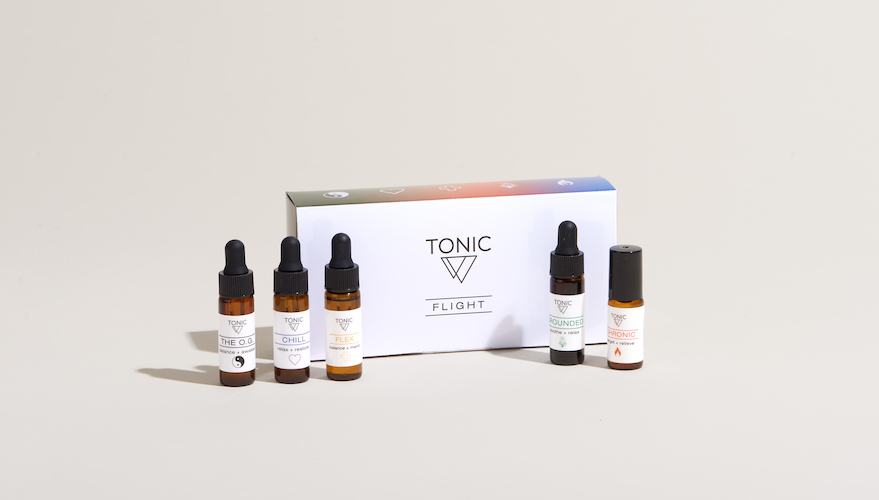
The TONIC Flight: Your Support, Your Way
Think of the TONIC Flight as a set of options, not instructions.
Not a rigid routine. Not a “take all of these every day or you have failed wellness.”
More like a lineup you can turn to depending on what your body is asking for.
Here’s how we use them, but you get to feel into what’s right for you, in any given moment.
Chill
When your nervous system is on high alert and everything feels a little too loud, too fast, too much. Chill helps take the edge off so you can exhale.
The O.G.
The everyday baseline. A balanced, versatile formula for stress/energy/mood support when you want to feel more steady, clear, and like yourself again.
Flex
For physical discomfort, tension, or inflammation. Flex supports recovery so you can move through your day with less resistance.
Grounded
When your thoughts are racing or you feel scattered and disconnected. Grounded helps bring you back into your body and into the present moment.
Chronic Roll-On
The only topical in the pack. For localized physical discomfort that needs targeted support. Think: headaches, knee pain, sore muscles, menstrual cramps, etc.
The Most Important Part
You do not need to take all of them. (Plot twist – you don’t need to take any of them!)
You do not need to take them perfectly.
You do not even need to take them every day.
Before reaching for anything, first ask: “What is my body trying to communicate with me?”
Then ask: “What would actually feel supportive right now?”
Some days it might be Chill.
Some days it might be Flex.
Some days it might be nothing at all.
You might take a break for a week and then come back to it.
That is not inconsistency. That is alignment.
The goal is not to follow rules. It is to build a relationship with your body where you trust what it is telling you.
And when you combine that awareness with the right kind of support things start to feel different. More intuitive, more responsive, less like you are forcing your way through life and more like you are actually in conversation with it.
Which, in a world that feels slightly unhinged, is a pretty solid place to be.