 The Steady Supply

 Personalized Vibes
How To Survive Jet Lag
There are few things more humbling than traveling across several time zones and discovering that your body has absolutely no intention of cooperating.
You arrive in Paris at 9 a.m. feeling like it should be midnight. You drink coffee because you’re exhausted. Then, at 11 p.m., you’re suddenly wide awake and wondering if the hotel has a 24-hour cheese plate.
Jet lag.
Jet lag happens when your body’s internal clock, or circadian rhythm, gets out of sync with the local time. Your sleep, hormones, body temperature, digestion and energy levels all follow circadian rhythms, and when you cross several time zones quickly, your body needs a little time to catch up.
The more time zones you cross, the more likely you’ll feel it. Eastward travel can be particularly challenging because you’re asking your body to fall asleep and wake up earlier than it naturally wants to.
The good news is you can help your body adjust easier with a few tips.

Light is your secret weapon
If you remember one thing from this article, make it this: light is one of the most powerful signals for resetting your body clock.
Morning light generally helps shift your circadian rhythm earlier, while later-day light can shift it later. This is why the timing of your sunlight exposure matters when you’re crossing time zones.
After you arrive to your destination, get outside and expose yourself to natural light during the appropriate local hours. If you’re traveling east, morning light is generally helpful for moving your schedule earlier. If you’re traveling west, later-day light can help shift it later.
And when it’s nighttime, dim the lights and make your bedroom as dark as possible.
Basically, you’re going to spend a few days gently gaslighting your brain about what time it is. But like, scientifically.

Start before you leave
If you’re crossing several time zones, don’t wait until you land to start adjusting.
For the few days before your trip, gradually move your bedtime and wake time toward your destination’s schedule. Going east? Try going to bed and waking a little earlier. Going west? Shift later.
You don’t need to completely rearrange your life. Even small changes can reduce the amount of adjustment your body has to make once you arrive.
Your circadian rhythm appreciates a heads-up.
Sleep according to your destination
Once you’re on the plane, start thinking in destination time. If it’s nighttime where you’re going, try to sleep. If it’s daytime, try to stay awake.
An eye mask, earplugs, comfortable clothes and a travel pillow can go a surprisingly long way toward convincing your body that the airplane is, in fact, a bedroom.
And if you’re on a long flight, get up and move periodically. Staying hydrated and wearing compression socks can also help with the physical discomfort that comes with long periods of sitting.
Compression socks won’t cure jet lag, but they may reduce travel-related leg swelling and can be a smart addition to a long-haul travel routine.

Hydrate, but don’t turn your bladder into a travel emergency
Flying, especially for many hours, can make it easy to fall behind on fluids.
Drink water regularly before and during your flight, and throw in some electrolytes for extra hydration.
Alcohol is another one to keep in check. It may make you sleepy initially, but it can disrupt sleep and make it harder to get the restorative rest you’re already desperately trying to find.
Don’t underestimate meal timing
Your digestive system has circadian rhythms, too, so eating according to your new local schedule can help reinforce the transition.
Once you arrive, start eating meals at approximately local mealtimes rather than continuing to eat based on the time zone you left.
Don’t go crazy – you don’t need to fast for 14 hours or follow an elaborate “jet lag diet.” Just eat nourishing meals at normal times and give your body consistent signals that you’re living in this new time zone now.

Be strategic with caffeine
Caffeine can be your best friend when jet lag has turned your brain into mashed potatoes, but timing matters.
Use caffeine earlier in the local day and avoid it too close to bedtime. Otherwise, you may successfully stay awake all afternoon only to discover that you’ve accidentally sabotaged the sleep you’re trying to get that night.
Another coffee at 6 p.m. can feel like a brilliant idea, but your 2 a.m. self may disagree.
Keep naps short
If you arrive at your destination and feel like you could sleep standing up, a nap can be tempting.
A short nap of around 20 to 30 minutes can help you function without making it as difficult to sleep that night. Longer naps can interfere with your sleep drive and prolong the adjustment.
The goal is a power nap. Not accidentally waking up four hours later with a pillow crease permanently etched into your face.

Chill TONIC for the “please let me sleep” portion of the trip
Sometimes you know it’s bedtime, your hotel room knows it’s bedtime, the sun went down hours ago… but unfortunately, your nervous system has other plans.
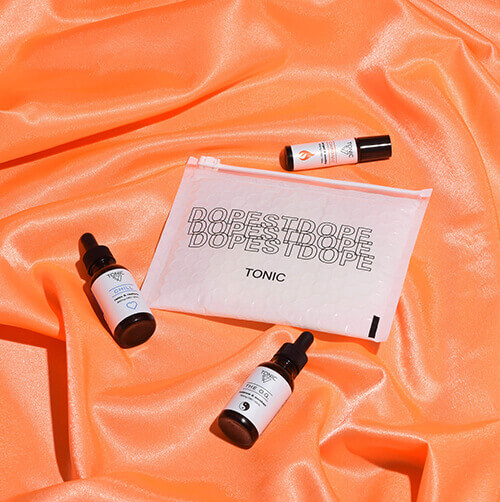
Chill TONIC combines CBD, Ashwagandha, Lemon Balm and Passionflower to support relaxation and a calmer state, making it a natural addition to your nighttime travel routine.
It can be especially nice when you’re trying to wind down on an overnight flight or settle into sleep after arriving somewhere your body clock hasn’t quite accepted as nighttime.
Sometimes your nervous system just needs everyone to stop asking things of it.

The O.G. TONIC for jet-lagged daytime you
Jet lag doesn’t just mess with sleep.. it can leave you dragging through the day with low energy, fuzzy focus and a mood that could best be described as “please don’t make me make a decision right now.”
The O.G. TONIC, with CBD and Ashwagandha, is designed for daytime balance, mood and focus, making it a useful companion when you’re trying to function while your body clock catches up.

Flex TONIC for the physical aftermath
Jet lag itself isn’t necessarily an inflammatory condition, but long flights, prolonged sitting, poor sleep and travel stress can leave you feeling stiff, sore and generally like you’ve been folded into a suitcase.
Flex TONIC combines CBD with black seed oil, also known as Nigella sativa. Black seed oil has been studied for antioxidant and anti-inflammatory effects, and clinical research suggests it may help support healthy inflammatory responses. (pubmed.ncbi.nlm.nih.gov)
It’s a particularly nice option if your trip involves hiking, skiing, lots of walking or other activities that leave your body asking for a recovery day after the vacation.
Because apparently sometimes you need a vacation from your vacation.

The jet lag game plan
You don’t need to completely outsmart your circadian rhythm, you just need to give it consistent signals.
Before you go: Gradually shift your sleep schedule toward your destination.
On the plane: Hydrate, consider electrolytes, move your body, limit alcohol, and sleep according to destination time when possible.
When you land: Get natural light, eat according to local time, stay awake during the local day and keep naps short.
At night: Make it dark, cool and quiet. Put the phone away. Give your body a chance to recognize that it’s actually bedtime.
And when you need a little extra support:
Chill TONIC for winding down and relaxation.
The O.G. TONIC for daytime balance, mood and focus.
Flex TONIC for the stiff, achy aftermath of long travel and poor sleep.
Jet lag may be an unavoidable side effect of being able to cross an ocean before your body has finished digesting breakfast, but it doesn’t have to hijack your entire trip.
Give your body the right signals, give it a little time, and eventually your internal clock will get the memo.