 The Steady Supply

 Personalized Vibes
From Wired to Wind-Down: The Evening Transition Protocol
You know the feeling: you finish your work day, and you’re so excited to go home (or at the very least, move from your desk to your couch) and finally take a load off.
But no matter how hard you try to relax, your brain has other plans.
Your thoughts are moving so fast you can almost feel them ping-ponging around in your head. One thought turns into five, then ten, then suddenly you’re replaying your entire day while also planning tomorrow.
Somehow, you’re exhausted and wired at the same time.
We’re all trying so hard to be “on” all day – productive, responsive, sharp, available – that by the time night rolls around, our system doesn’t know how to downshift.
The truth is, most of us don’t end our day… we just stop working and expect our nervous system to magically catch up.
It doesn’t work like that. Here’s what does work.

Why We Stay “On” at Night
Your body operates on signals.
If your day looks like:
- Laptop closes → immediately on your phone
- Emails → dinner → TV → scrolling → bed
Your brain never gets the message that it’s safe to power down.
From a biological standpoint, you’re still in go-mode:
- Cortisol (your stress hormone) is elevated
- Your nervous system is in a low-grade fight-or-flight state
- Your mind is still processing, planning, anticipating
So even if you feel tired, your system is wired for alertness.
To shift into rest, you need a transition.

The Solution: A 3-Phase Wind-Down Ritual
Think of this as your nightly “offboarding process” from the work day.
Instead of expecting instant calm, you guide your body through it step by step.
Phase 1: Physical Release
Before your mind can relax, your body needs to let go of stored tension.
Stress doesn’t just live in your thoughts, it lives in your muscles, your breath, your posture.
Try this:
- A short walk (even 10–15 minutes)
- Gentle stretching or yoga
- Shaking out your limbs (sounds weird, works incredibly well)
- A hot shower to physically “rinse off” the day
This phase is about moving stress out of the body so it doesn’t follow you into the night.

Phase 2: Mental Offload
Your brain loves unfinished business. If you don’t give it closure, it will just keep working.
Instead of trying to “stop thinking,” give your thoughts somewhere to go.
Try this:
- Write a simple to-do list for tomorrow
- Brain dump everything on your mind (no structure needed)
- Journal one thing that felt good today
This signals: “Nothing is being forgotten. You can rest now.”

Phase 3: Nervous System Calm
This is where the real magic happens.
Your nervous system needs cues of safety to transition into rest-and-digest mode. This is the phase most people skip, and the one that changes everything.
Create a ritual that feels calming, consistent, and a little indulgent.
Try this:
- Orient yourself to the room: slowly look around and name 5 things you see
- Put your bare feet in the grass
- Slow, intentional breathing (try 4-6 breathing: inhale 4, exhale 6)
- Hum softly or play with vocal toning (stimulates the vagus nerve)

Where Chill TONIC Fits In
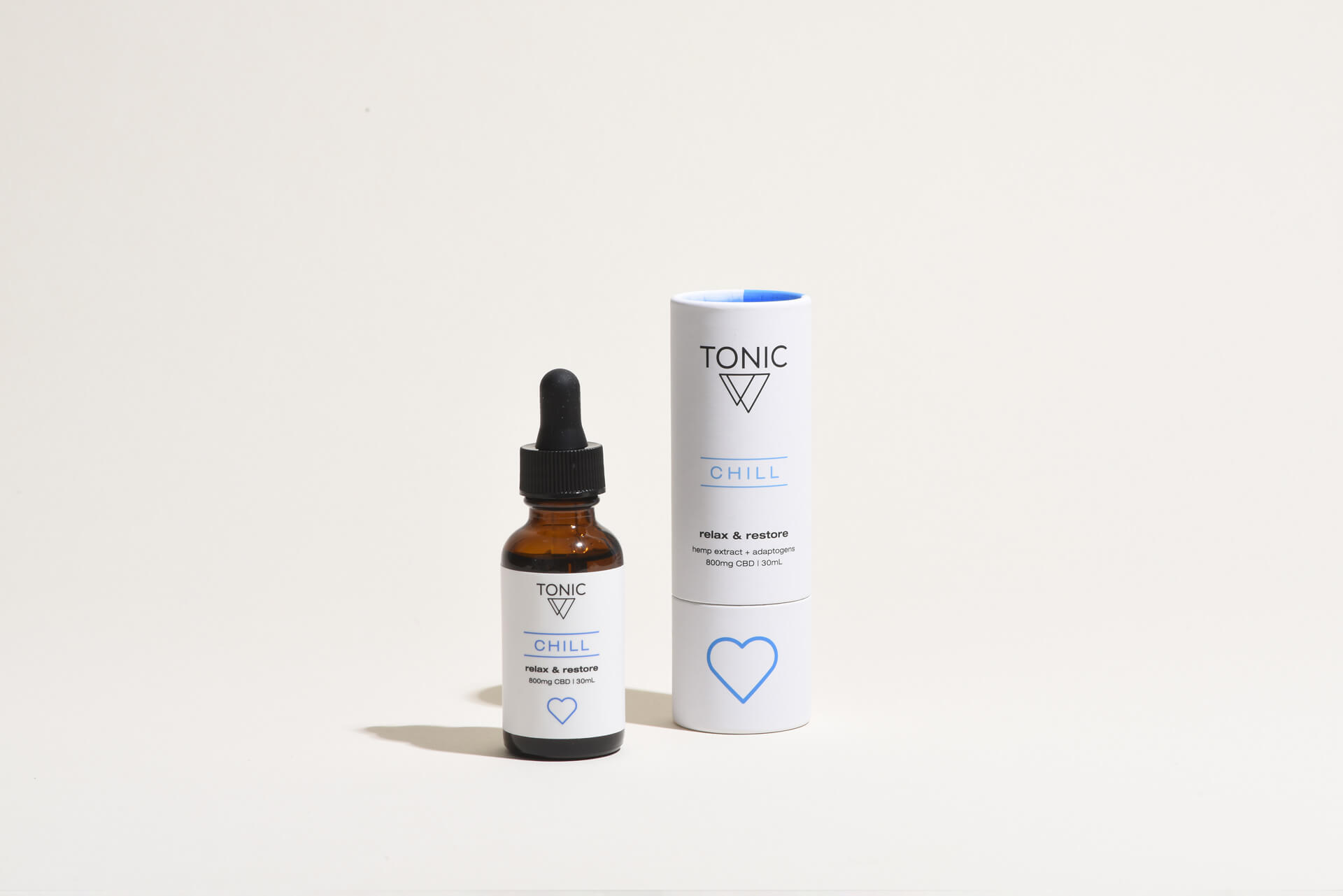
Meet your nervous system’s favorite nightcap: Chill TONIC.
Formulated with CBD, ashwagandha, lemon balm, and passionflower, this blend is designed to help your body actually downshift, not just pretend to.
Each dropper delivers calming, restorative support for both mind and body, without heaviness or next-day grogginess.
And just as a bonus- it’s also blended with black seed oil, which enhances antioxidant, anti-inflammatory, and immune-supportive benefits.
But what makes this formula special is how the ingredients work together.
Why Chill TONIC Works So Well
CBD: The Anchor
CBD is the foundation of TONIC, and for good reason.
It interacts with your body’s endocannabinoid system (ECS), a regulatory network that helps maintain balance across mood, stress response, sleep, inflammation, and more.
Instead of forcing a specific outcome, CBD works more like a modulator, helping bring systems back into equilibrium.
What research suggests:
- A 2019 study published in The Permanente Journal found that CBD improved sleep scores in 66.7% of participants within the first month and reduced anxiety in 79.2%.
- A 2011 study in Neuropsychopharmacology showed that CBD significantly reduced anxiety in individuals with social anxiety during a simulated public speaking test.
- Preclinical research suggests CBD may support GABA signaling and reduce overactive stress responses (Blessing et al., 2015).
In the context of your evening routine, CBD helps take the edge off an overactive nervous system, making it easier to transition into a calm, grounded state.

Ashwagandha: Your Stress Regulator
Ashwagandha is one of the most well-studied adaptogens when it comes to stress resilience and cortisol regulation.
What research shows:
- A randomized, double-blind study (Chandrasekhar et al., 2012) found that participants taking ashwagandha had significantly reduced cortisol levels and reported lower stress and anxiety scores.
- Another study (Lopresti et al., 2019) showed improvements in stress, sleep quality, and overall well-being.
By helping regulate cortisol, ashwagandha supports your body’s ability to move out of “panic mode” and into a more balanced, restorative state.
Lemon Balm: The Mental Exhale
Lemon balm shines when it comes to calming the mind and supporting cognitive function under stress.
What research shows:
- A clinical study (Kennedy et al., 2004) found that lemon balm improved mood and cognitive performance while reducing stress.
- Another study (Cases et al., 2011) showed significant reductions in anxiety and insomnia symptoms, with up to 85% of participants experiencing improvement in sleep.
Mechanistically, lemon balm helps inhibit the breakdown of GABA and supports acetylcholine activity, making it a powerful ally for both calm and clarity.

Passionflower: The Deep Calm Switch
Passionflower is especially helpful for racing thoughts, restlessness, and sleep disturbances.
What research shows:
- A double-blind study (Akhondzadeh et al., 2001) found passionflower to be comparable to a pharmaceutical treatment for generalized anxiety disorder—with fewer side effects.
- A study published in Phytotherapy Research (Ngan & Conduit, 2011) showed improved sleep quality with passionflower consumption.
It works primarily through GABA pathways, helping quiet excess brain activity and support deeper, more restorative sleep.
The Synergy Effect
Here’s where it gets really interesting:
- Lemon balm helps preserve GABA
- Passionflower activates it
- Ashwagandha lowers the stress load
- CBD helps regulate the entire system
Together, they create a full-body exhale. A trifecta! Or rather, a quadfecta!???

How to Use This Protocol
You don’t need to overhaul your entire night.
Start here:
- Pick one habit from each phase
- Keep it simple and repeatable
- Add Chill TONIC during whichever phase feels best to you – ever heard of habit stacking?😉
- Stay consistent for a few nights and you’ll be hooked
Even a 20-30 minute intentional wind-down can completely change how you feel at night – and how you wake up in the morning.
The trick is to stop fighting your biology and start working with it🤝